
The Definitive Car Tyre Buying Guide
Your car's tyres are the sole point of contact with the tarmac, occupying a combined contact patch barely larger than four postcards. Selecting the right tyre requires balancing speed ratings, load endurance, casing construction (Tubeless, Anti-Puncture Liquid, or Run-Flat), and seasonal tread designs engineered specifically for punishing Indian road temperatures and monsoon downpours.
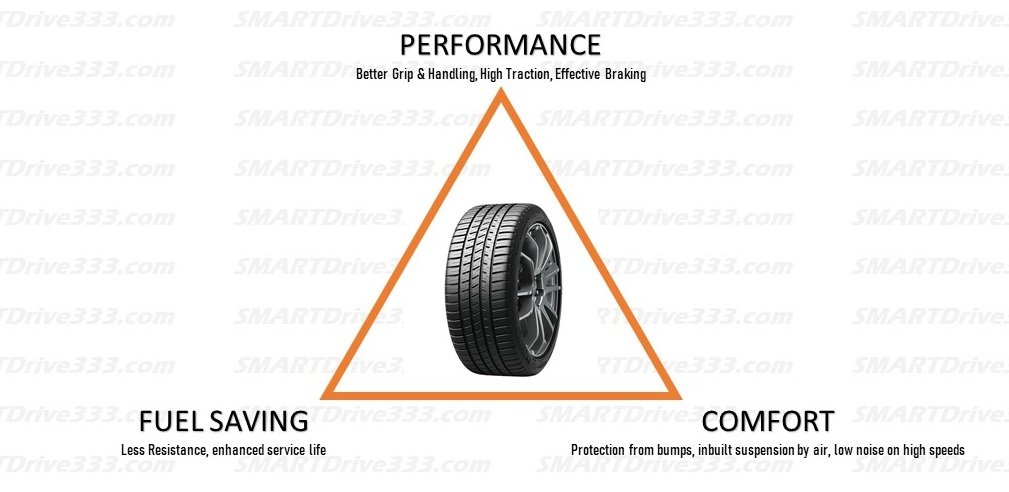
The Tyre Decision Triangle: Performance, Fuel Economy & Comfort
1. Performance & High-Speed Grip
Engineered with softer, high-silica rubber compounds and wide shoulder tread blocks. They provide superior contact traction, immediate steering response, and shorter wet/dry braking distances at speeds above 100 km/h on expressways.
2. Fuel Saving & High Tread Life
Built with hard synthetic polymer compounds designed to minimize rolling resistance. By reducing frictional drag against the road, these tyres improve fuel economy by 3% to 5% and provide high endurance, frequently reaching 65,000 to 80,000 km.
3. Ride Comfort & Low Cabin Noise
Features supple, flexible sidewall plies and sound-dampening closed-groove tread patterns. Designed to absorb sudden pavement ruts, bridge expansion joints, and rough tarmac without transmitting harsh vertical shocks to car passengers.
Speed Ratings, Load Index & Tyre Pressure Tables
| Speed Symbol | Max Speed Rating | Typical Vehicle Application | Thermal Endurance Profile |
|---|---|---|---|
| N | 140 km/h (87 mph) | Spare tyres, light commercial pickups | Basic city speed limits only |
| P | 150 km/h (93 mph) | Compact delivery vans, auto-rickshaws | Low heat resistance |
| Q | 160 km/h (99 mph) | Rugged 4x4 off-road tyres (A/T & M/T) | Heavy ply carcass, high friction heat build-up |
| R | 170 km/h (106 mph) | Heavy passenger vans, utility crossovers | Moderate continuous expressway tolerance |
| S | 180 km/h (112 mph) | Entry hatchbacks (Alto, Kwid, WagonR) | Standard city and secondary highway cruising |
| T | 190 km/h (118 mph) | Premium hatchbacks & compact sedans (Swift, Dzire) | Reliable summer highway cruising up to 120 km/h |
| H | 210 km/h (130 mph) | Midsize sedans & crossovers (Ciaz, Brezza, Creta) | High thermal dissipation for long expressway stretches |
| V | 240 km/h (149 mph) | Turbo petrols, executive sedans (Slavia, Virtus) | Reinforced crown cap to resist centrifugal distortion |
| W | 270 km/h (168 mph) | Luxury sedans & high-performance SUVs | Ultra-high-speed endurance, track-tested silica blend |
| Y | 300 km/h (186 mph) | Sports cars, high-output German performance models | Extreme thermal stability with zero bead slip |
Load Index Capacity Chart
| Load Index | Max Weight Capacity (Per Tyre) | Axle Capacity (Pair) | Common Indian Car Fitments |
|---|---|---|---|
| 75 | 387 kg (853 lbs) | 774 kg | Entry A-segment city hatchbacks |
| 79 | 437 kg (963 lbs) | 874 kg | Compact hatchbacks (Tiago, Celerio) |
| 82 | 475 kg (1,047 lbs) | 950 kg | B-segment hatchbacks (Baleno, i20, Altroz) |
| 85 | 515 kg (1,135 lbs) | 1,030 kg | Sub-4M sedans (Amaze, Dzire, Aura) |
| 88 | 560 kg (1,235 lbs) | 1,120 kg | Midsize sedans (Ciaz, Verna, City) |
| 91 | 615 kg (1,356 lbs) | 1,230 kg | Compact & midsize SUVs (Brezza, Creta, Grand Vitara) |
| 95 | 690 kg (1,521 lbs) | 1,380 kg | Full-size crossovers & MPVs (Ertiga, Carens, Slavia) |
| 98 | 750 kg (1,653 lbs) | 1,500 kg | Heavy MPVs & D-segment SUVs (Harrier, Safari, XUV700) |
| 101 | 825 kg (1,819 lbs) | 1,650 kg | Premium 7-seaters & touring MPVs (Innova Hycross) |
| 104+ | 900+ kg (1,984+ lbs) | 1,800+ kg | Body-on-frame 4x4s (Fortuner, Scorpio-N, Thar) |
Always inspect tyre pressure before driving or after the car has been parked for at least 3 hours. Driving just 2 km generates internal air friction, raising hot tyre readings by 3 to 4 PSI.
On high-speed concrete corridors like the Samruddhi Mahamarg, continuous friction expands air volume by 15–20%. Never under-inflate tyres before an expressway run, as sidewall flex causes blowouts.
Look for the Uniform Tire Quality Grading: Treadwear (e.g., 200 = track-soft, 400 = balanced, 600 = hard fleet), Traction (AA, A, B), and Temperature resistance (Grade A required for Indian summers).
Tubeless, Liquid Sealant & Run-Flat Tyres
1. Standard Tubeless Tyres
Uses an airtight halobutyl inner liner bonded directly to the tyre casing instead of a rubber inner tube. The tyre bead locks air directly against the alloy or steel wheel rim flange.
- ✓ Slow air leakage during puncture, giving time to pull over safely.
- ✓ Low rolling resistance and minimal internal friction heat build-up.
- ✓ Cheap, roadside-reparable using external rubber strip or mushroom plug.
- ✗ Instant total deflation if the rim bead unseats during a severe pothole hit.
2. Tubeless with Anti-Puncture Liquid
A specialized viscous glycol/latex sealant injected through the valve stem. Centrifugal force coats the inner tread crown, instantly sealing punctures up to 4–6 mm.
- ✓ Prevents roadside strandings from ordinary nails, screws, and road thorns.
- ✓ Seals air leaks immediately with virtually zero loss of tyre pressure.
- ✗ Adds 250–400g rotational unbalance if sealant clumps due to long parking.
- ✗ Chemical dries out after 24–36 months and cannot seal sidewall slashes.
3. Run-Flat Tyres (RFT)
Engineered with heavily reinforced, heat-resistant rubber inserts inside the sidewalls. The stiff sidewalls support vehicle weight even after total loss of air pressure.
- ✓ Drive up to 80 km at 80 km/h with zero air pressure to reach safety.
- ✓ Eliminates dangerous roadside tyre changes on dark high-speed expressways.
- ✗ Noticeably stiffer ride quality with sharp thuds transmitted over potholes.
- ✗ Heavy unsprung weight, high replacement cost, and often non-reparable.
Tyres by Vehicle Class & Usage Purpose
1. City Hatchbacks & Compacts
Treadwear 400+Prioritizes low rolling resistance, hard compound longevity, and flexible sidewalls for city traffic and rough roads. Sized with taller 65–80 aspect ratios to cushion against sharp road craters.
2. Midsize & Executive Sedans
Asymmetric TreadRequires balanced high-speed expressway tracking, low cabin road noise, and sharp cornering response. Uses asymmetric tread blocks with dedicated inner wet-sipes and outer dry-shoulder ribs.
3. Compact & Midsize SUVs
Highway Terrain (H/T)Built with reinforced ply cords and rim protector flanges to defend 16 to 18-inch diamond-cut alloy wheels from curb rash, paired with deep water-evacuation channels for high-speed rain safety.
4. Heavy Touring MPVs
Heavy Load (XL)Vehicles like the Innova Hycross, Crysta, and Ertiga carry 7 to 8 adults and heavy boot luggage. Requires stiff multi-ply carcass construction to prevent high-speed body roll and rear tyre sidewall sag.
5. Rugged 4x4s & Off-Roaders
All-Terrain (A/T)Vehicles like the Thar, Scorpio-N, and Jimny need thick tread lugs, stone-ejector ribs, and cut-and-chip resistant rubber compounds to crawl over loose rocks, mud trails, and broken gravel surfaces.
6. Performance & Track Cars
Ultra High PerformanceFeatures ultra-soft track compounds, shallow tread grooves, and stiff sidewalls with low 40–45 aspect profiles to maximize contact patch grip under aggressive acceleration and threshold braking.
Seasonal Compounds & Indian Road Conditions
1. Extreme Summer Heat & Concrete Expressways
In hot Indian summers, road surface temperatures exceed 55°C. At high expressway speeds, air friction causes internal tyre pressure to expand by 4–6 PSI. Select tyres with UTQG Temperature Grade A and high thermal dissipation compounds to prevent carcass delamination.
Thermal Defense: Grade A Heat Resistance2. Monsoon Wet Grip & Aquaplaning Sipes
Water pooling on highways creates a wedge between the tyre tread and tarmac, causing total steering loss (aquaplaning). Tyres with wide longitudinal channels and lateral sipes displace up to 30 litres of water per second at 80 km/h to maintain contact.
Hydro-Grooves: 30L/sec Water Displacement3. HT vs AT vs MT Terrain Architecture
Highway Terrain (H/T) delivers 85% on-road quietness and wet braking. All-Terrain (A/T) balances 50% road and 50% broken trail durability with reinforced puncture plies. Mud Terrain (M/T) features open shoulder block voids to dig through monsoon sludge.
Terrain Ratio: H/T (Road) vs A/T (Trail) vs M/T (Mud)Tyre Inspection, Tread Wear & Replacement Rules
Determining when to replace your tyres is a critical safety calculation rather than guesswork. Every road tyre features molded Tread Wear Indicators (TWI)—small 1.6 mm raised bars located inside the main longitudinal grooves. When tread rubber wears flush with these indicator bars, remaining wet traction drops by 70%, creating severe aquaplaning risks on wet highways.
Even with substantial remaining tread depth, rubber compound undergoes structural aging. Check the 4-digit DOT date code molded into the sidewall (e.g., "1823" indicates the 18th week of 2023). In hot climates, rubber plasticizers evaporate, causing micro-cracking and hard dry-rot within 5 to 6 years regardless of odometer reading.
Perform monthly visual audits for sidewall bulging, egg-shaped blisters, and uneven edge wear. A sidewall bubble indicates broken internal polyester/steel cord plies caused by a sharp pothole hit; such tyres are structurally compromised and require immediate disposal to prevent high-speed blowouts.
Essential Tyre Health Checklist
- 1.6 mm Legal Minimum TWI: Replace tyres before tread blocks wear flush with the molded wear indicators.
- 5-Year Age Ceiling: Scrap tyres exceeding 5 years of age due to compound dry-rot and internal ply hardening.
- Zero Sidewall Bubble Tolerance: Replace any tyre showing a sidewall bulge immediately; internal cord plies are torn.
- 10,000 km Rotation Cycle: Rotate tyres front-to-rear or cross-pattern to balance drivetrain wear.
- Alignment & Balancing: Perform wheel alignment and dynamic balancing whenever steering pulls or vibrates at 80 km/h.